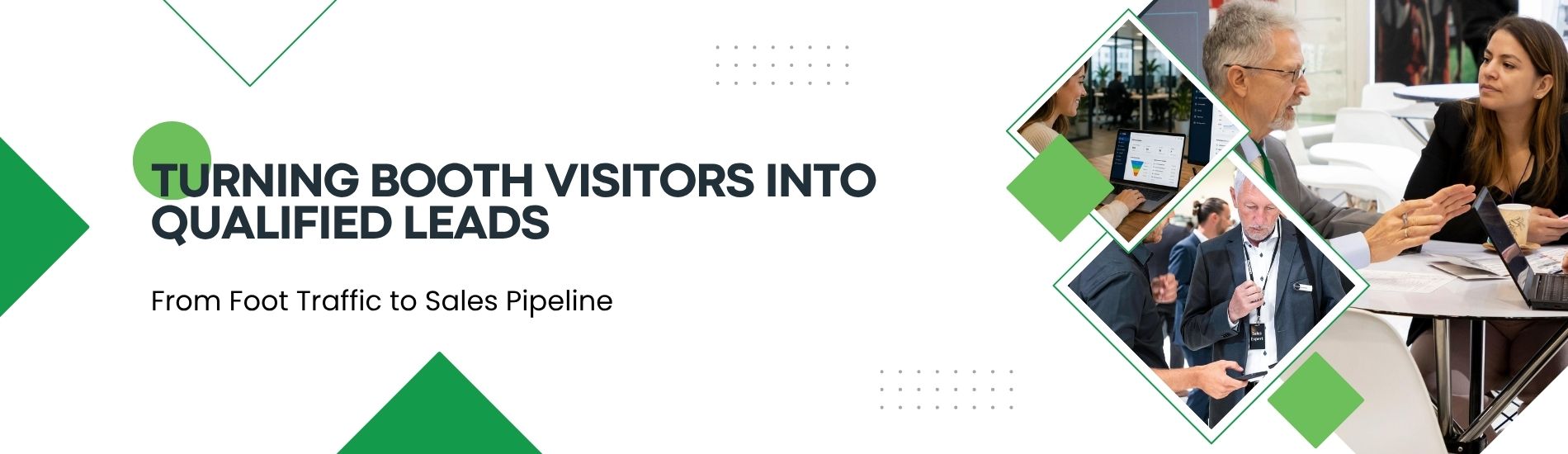
Turning Booth Visitors Into Qualified Leads
Turning Booth Visitors Into Qualified Leads: A Practical Guide
A busy booth feels like success while it's happening. But foot traffic on its own doesn't pay for the stand, the travel, or the staff time it took to get there. What actually justifies an exhibition budget is what happens after someone stops: whether that visitor gets qualified, captured properly, and followed up with in a way that moves them toward a decision.
This is where many otherwise well-run exhibition programmes lose value. A 2010 industry survey by Lynch Exhibits and In4med found that fewer than 70% of exhibitors had any formal plan in place for following up on leads after a show, and only 47% tracked those leads through the rest of the sales cycle. In other words, the gap usually isn't at the booth — it's in the qualification and follow-up process around it.
Redefine What a "Good Lead" Looks Like
Not every business card, badge scan, or brochure request is a lead worth chasing. Before the show, define what a qualified lead actually looks like for your business — job title, company size, industry, budget authority, or a specific buying signal. Without this definition, staff default to collecting contact details from anyone who stops, which produces a long list with little to act on afterwards.
Write this down as a short, simple checklist your whole team can use in the moment. The goal isn't to gatekeep conversations — it's to make sure the right conversations get flagged for fast, meaningful follow-up instead of getting lost in a pile of generic contacts.
Ask Questions That Do the Qualifying for You
The booth conversation itself is where qualification happens. A handful of well-chosen questions, asked naturally rather than as an interrogation, can tell your team almost everything they need to know:
- What brought you to the stand today — are you researching, comparing options, or ready to move?
- What's driving the need right now?
- Who else is involved in this decision?
- What timeline are you working toward?
The answers let staff sort visitors into hot, warm, and cold categories on the spot, which matters enormously for what happens next. A hot lead handled with the same generic follow-up as a casual browser is a wasted opportunity; a cold lead chased too aggressively can do more harm than good.
Capture Details Properly, Not Just Quickly
Manual note-taking and business-card piles are where good leads quietly disappear. Badge-scanning apps, tablets connected to a CRM, and short digital qualification forms all solve the same problem: they capture not just contact details but the context of the conversation — what was discussed, what was requested, and how the lead was scored — while it's still fresh.
That context is what makes personalised follow-up possible. A follow-up email that references a specific conversation converts at a meaningfully higher rate than a templated "great meeting you" message sent to everyone who walked past the stand.
Score Leads Before You Leave the Show Floor
Lead scoring doesn't need to be complex. A simple hot/warm/cold system, applied consistently by every staff member, is enough to guide what happens in the first 48 hours after the show:
- Hot — clear buying intent, budget, and timeline. Route directly to sales for a same-day or next-day personal follow-up.
- Warm — genuine interest but an unclear timeline or missing decision-makers. Follow up with tailored content and a scheduled check-in.
- Cold — early-stage interest or a brand awareness touchpoint. Add to nurture campaigns rather than direct sales outreach.
Doing this at the show, rather than trying to reconstruct it from memory afterwards, is what keeps the follow-up process from stalling once everyone is back in the office and buried in post-show admin.
Speed Is the Single Biggest Lever You Have
Timing has an outsized effect on conversion. Research from Harvard Business Review on lead response found that contacting a new lead within 24 hours can improve conversion likelihood by around 60% compared with slower follow-up, and studies of LinkedIn outreach show response rates roughly three times higher when a message is sent within 48 hours of an event, compared with reaching out later. The lead's memory of the conversation fades fast, and a competitor who responds first often wins the next conversation by default.
Build the follow-up sequence before the show starts, not after it ends. Hot leads should have a personal message drafted and ready to send the same day; warm leads should have a short nurture sequence queued; cold leads should be added automatically to your broader marketing list.
Common Reasons Good Leads Go Cold
Even with strong booth traffic, leads slip away for predictable reasons:
- No shared definition of what counts as a qualified lead
- Notes taken on paper or scattered across individual staff members' phones
- No lead scoring applied before the show ends
- Follow-up delayed until the team is back in the office days later
- Generic, unpersonalised follow-up messages sent to everyone equally
Each of these is a process fix rather than a budget fix — which means the return on your next show can improve significantly without spending a single extra euro on the stand itself.
From Booth Traffic to Pipeline
A crowded booth is only the first half of the equation. The businesses that consistently get strong returns from exhibitions are the ones that treat lead qualification and follow-up as seriously as booth design — with clear criteria, proper capture tools, fast scoring, and a follow-up sequence ready to go before the show even opens.
Fountainhead International B.V. works with exhibitors across Europe to make sure the stand itself supports this process — from layouts built around natural conversation points to spaces designed for the kind of engagement that produces real, qualifiable leads. If you're planning your next show, we can help you design a stand that does more than attract a crowd.
Latest Blogs
© Copyright by FOUNTAINHEAD INTERNATIONAL B.V. || Designed and maintained by S2code