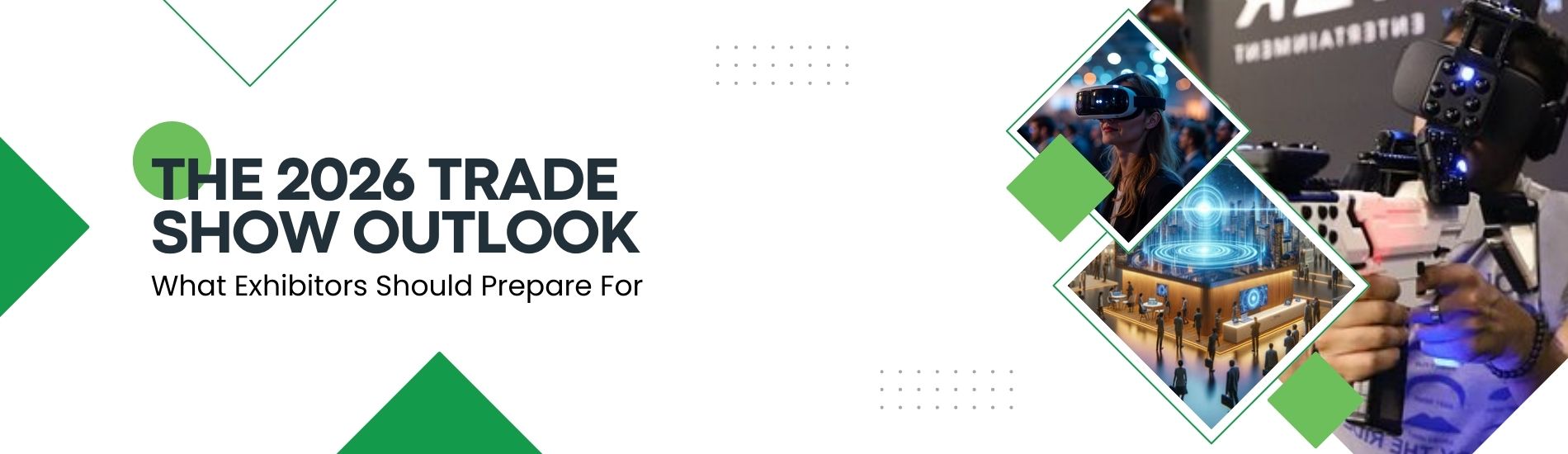
The 2026 Trade Show Outlook: What Exhibitors Should Prepare For This Year
Trade shows in 2026 are still happening at scale. Floors are still filled with activity, calendars are still filled with events, and the budget is still available. But what many of them quietly admit is that something changed. The same shows, the same amount of effort, and indeed the same events just do not produce the same results as they used to.
This does not mean trade shows are no longer relevant. This just means the room for unfocused exhibiting has narrowed.
In 2026, trade shows are still one of the few places where real business discussions occur face-to-face, although increasingly they are rewarding those who arrive prepared, not just present.
Trade Show Attendance Is Not the Problem, Exhibitor Expectations Are
Trade shows are still important from a commercial perspective. Research shows that a vast percentage of trade show attendees with buying authority arrive at the show with buying authority or influence.
According to industry statistics, over 80% of trade show attendees are involved in purchasing decisions. This is why trade shows attract vast marketing budgets year after year.
There has been a change in internal conversations. The question of whether the marketing team had been busy at the booth is no longer relevant today.
The new question that matters today is whether:
- time spent at the show has reduced sales cycles,
- improved visibility of buyer intent,
- opened new doors that were previously inaccessible digitally, and
- improved overall trade show ROI.
It is in this area that most exhibitors have failed, as they attend the correct events and the correct people, but don't link everything effectively. Leads have been generated but not addressed, the interaction is taking place but losing context, and the follow-up is being sent out, but is not relevant as the interaction was never clearly defined.
In 2026, the expectations are clearer. Trade shows are seen as decision environments rather than awareness environments. Exhibitors coming to the trade show without a clear idea of what constitutes an acceptable level of interaction are frequently waking up to the realisation that they cannot filter out the very valuable interest from the unqualified attendance.
Hybrid Did Not Win on Innovation, It Won on Practicality
Nearly half of trade shows now incorporate a hybrid or virtual aspect, which means exhibitors now have an even greater reach beyond the confines of the show itself. This is not about replacing physical interaction for many exhibitors; this is about continuity.
This facilitates pre-event involvement among registered attendees, remote access for stakeholders who are unable to travel, and the possible use of materials after and in relation to the event. This matters because the way that exhibits are judged is no longer based on how lively the exhibits look over the course of three days.
The most benefited exhibitors in hybrid events are not those who are using technology to put on a show. It is those who are using technology to continue the dialogue after the show and keep the momentum going.
Booth Design Has Become a Filtering Tool
Most exhibitors are still thinking about their booths in terms of attraction, while in 2026, the operative word will be filtration.
The trade show floor is crowded, and everyone has short attention spans. Therefore, people move around quickly and tend to make quick decisions on where to pay attention. According to research, trade show booths today account for about 40% of the overall event budget for booth design and presentation, not just for the sake of design, but to properly regulate people's attention.
What works is not always what looks impressive, but what communicates relevance. High-performing booths typically have cues that:
- Make it clear who they are targeting,
- Provide a clear ask, such as a demo or conversation, and
- Minimise the effort required to initiate the next step.
Booths trying to engage everyone struggle to engage anyone effectively.
Data Has Shifted from “Nice to Have” to “Necessary”
There was a day when lead generation was sufficient. Today, in 2026, it is rarely so. Exhibitors find themselves in a world where most of their marketing efforts are measurable, trackable, and optimised.
Trade shows are no different. Show organisers are increasingly providing detailed analytics, from traffic patterns at the booth to attendance at sessions, and their own teams are demanding that exhibitors make sense of this information, not just dismiss it.
The point that is often missed is that data does not necessarily mean clarity. Without planning, more data often means more confusion. Exhibitors may know how many people visited their booth, but not:
- Why they came,
- What they were interested in, or
- Whether the interaction went beyond surface-level interest.
It is for this reason that the data strategy must be determined before the show, not after. Exhibitors who determine what matters, such as meaningful conversations, qualified needs, and decision timelines, are better equipped to identify the right signals during the show. Those who do not are left with impressive numbers that do little to drive action.
What this means is that exhibitors must plan their interactions to naturally produce insight. Demos should show intent. Conversations should capture context. Follow-ups should be behaviour-driven, not assumption-driven.
Sustainability in Trade Shows Is Being Noticed, Quietly but Clearly
Sustainability is not something that generates attention; instead, people notice it in the background. According to various studies, people within any trade show and events numbering over 81% gravitate towards events and brands that show they take sustainability seriously. However, some trade shows are setting carbon-neutral objectives within ten years’ time.
As for the exhibitors, no grand gestures are required here. Just practical decisions – like green booths, less paper clutter, smart swag, and efficient logistics as part of sustainable exhibiting practices.
When these decisions are executed well, they do not ask to be noticed. The missteps, however, do the talking, while the effective decisions create the trust quietly. Sustainability in 2026 is not about shouting; it is about baseline credibility.
Exhibitor Staff Preparation Still Determines Trade Show Outcomes
Even though the design and tech have become much better, human interaction remains the most vital factor.
Reports from the industry always point to the fact that 85% of the success is still from the performance and behaviour of the people at the booths. Businesses that are successful at trade shows have the ability to:
- Ensure proper synchronisation of their booths,
- Clearly comprehend the meaning of a quality lead,
- Train their staff to be receptive instead of being pushy, and
- Collect context together with the lead’s contacts.
What Exhibitors Should Actually Prepare for in 2026 Trade Shows
Discipline, not flash, is the source of a strong show result in 2026. Exhibitors win by tightening the basics, not chasing every new trend. It starts before you buy a booth: define what success looks like, clearly in business terms; confirm that the audience fits current priorities.
Once you decide to participate, map engagement across pre-event, on-site, and post-event stages so that booth design, staff, and data capture all fit concrete objectives. Measure performance by outcomes at the event, not by activity. Prompt follow-up on qualified leads and frank notes about what worked and didn’t.
Eventually, trade shows aren't about more. They're about less-more on purpose. These fundamentals increasingly define successful trade show strategy in 2026. The real difference isn't the event itself; it's in how you prepare for it.
Latest Blogs


© Copyright by FOUNTAINHEAD INTERNATIONAL B.V. || Designed and maintained by S2code