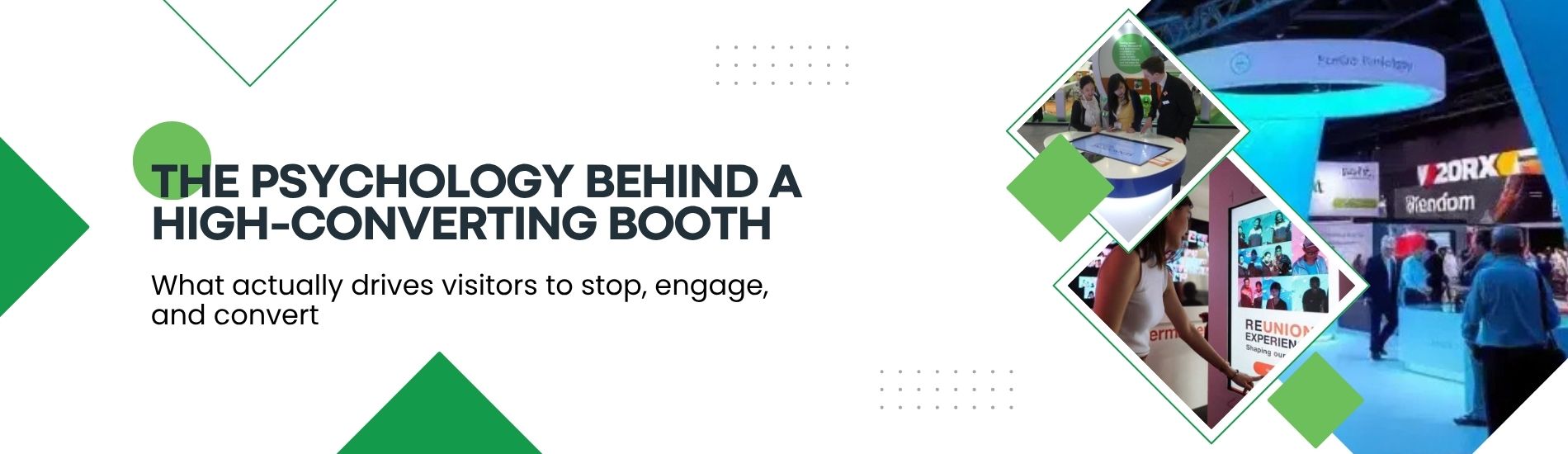
The Psychology Behind a High-Converting Booth
The Psychology Behind a High-Converting Booth
What actually drives visitors to stop, engage, and convert
In 2023, the Centre for Exhibition Industry Research found that 81% of attendees at trade shows have purchasing authority and that nearly 77% of attendees find at least one new supplier at a trade show. These aren’t people casually strolling through a trade show. They’re decision-makers with a purpose.
But the vast majority of booths still aren’t converting this interest into action.
It’s not always a problem with the design quality or the product's strength. It’s a fundamental misunderstanding of the way people behave in a state of high pressure and high choice. A successful booth is successful because it matches the way people think, decide, and behave in real-time.
Cognitive Load: Why Simplicity Wins
Trade shows are cognitively taxing. So many brands, so many messages, and an endless amount of noise.
According to Nielsen Norman Group, users typically read only 20–28% of the text on a page in digital environments. In exhibitions, where attention is even more fragmented, that number drops further.
This is why complex trade show booths are unsuccessful.
People don’t analyse information at trade shows. They merely scan it. If your booth's message is unclear, it will likely be ignored. Successful trade show booths are those that minimise cognitive load:
- Minimal text
- Strong visual hierarchy
- One clear takeaway
Instead of asking visitors to think harder, they make understanding effortless.
The “Approach-Avoidance” Effect
Psychologists use the terms approach (move towards) and avoidance (move away) to explain the process.
In the trade show setting, the process can be measured in mere seconds.
A booth that is perceived as too aggressive or sales-oriented, or simply too crowded, can lead to avoidance behavior. People tend to walk around the booth. Conversely, a booth that is perceived as neutral or welcoming can elicit approach behaviour.
That is why the design details can be so important:
- Unobstructed entryways
- Staff positioned to encourage entry
- Space to allow people to pause without pressure
When people feel they have control over the interaction, they’re more likely to step in.
Micro-Commitments Drive Conversions
A major mistake exhibitors make is aiming directly for big conversions: long demos, detailed discussions, or immediate deals.
But human psychology doesn’t work that way.
Research from Harvard Business Review highlights that small initial commitments significantly increase the likelihood of larger follow-up actions.
In a booth context, this means:
- A quick question instead of a pitch
- A 30-second interaction instead of a 10-minute demo
- A simple scan or sign-up instead of a full conversation
Once a visitor says “yes” to something small, they are psychologically more inclined to continue engaging.
Visual Anchoring: Where Attention Settles First
Eye-tracking studies consistently show that people focus first on dominant visual elements before reading anything else.
This is known as anchoring.
If your booth’s strongest visual doesn’t communicate value, attention is wasted. High-performing booths use anchors intentionally:
- A bold headline placed at eye level
- A striking visual that reflects the outcome, not the process
- A clear focal point visible from a distance
Once attention is anchored correctly, everything else becomes easier to process.
The Role of Social Density
There’s a fine balance between an empty booth and an overcrowded one.
Behavioural research shows that moderate crowd density increases perceived value, while extreme crowding reduces comfort. This is often referred to as the “social density effect.”
In exhibitions, this translates into a simple insight:
People are drawn to activity, but only if it feels accessible.
High-converting booths manage this by:
- Keeping interactions near the front
- Avoiding deep, closed meeting zones
- Allowing visibility into what’s happening inside
The goal isn’t to look busy. It’s to look engaging.
Time Perception and Engagement
Not only do visitors decide where to stop, but they also decide how long to stay.
What makes “engaging” is not always how complex the interaction is. What makes “engaging” is how the interaction makes the visitor feel about the passage of time.
If the interaction is long or confusing, the visitor becomes disengaged right away. If the interaction is fast and rewarding, the visitor stays engaged without even noticing the passage of time.
That is the power of structured engagement:
- Clear starting point
- Quick value delivery
- Optional deeper engagement
When time feels well spent, conversion becomes a natural next step.
Decision Fatigue Is Real
By mid-day, the attendees had already interacted with several brands. At this point, their capacity for decision-making is impaired. This is referred to as decision fatigue. At this point, people do not look for the best; they look for the easiest.
A high-converting booth makes the decision-making process easier through a call-to-action like scan, book, or try, limiting the choices, and making the benefits clear. The easier the decision-making process, the higher the chances of converting.
Bringing It Together
A booth that converts isn’t just aesthetically pleasing. It’s also psychologically consistent with the way visitors behave.
It saves effort, piques curiosity, and directs action without forcing it.
Most important of all, it honours the way people actually behave in exhibitions:
- They scan, they don’t study.
- They explore, they don’t commit.
- They respond to ease, not complexity.
Final Thought
The fact that trade shows represent one of the few places where attention, trust, and decision-making occur face-to-face is what makes them so powerful and so unforgiving. You get only a few seconds to grab attention, not a few chances. When your exhibit is designed with psychology in mind, those few seconds can be all you need.
Latest Blogs


© Copyright by FOUNTAINHEAD INTERNATIONAL B.V. || Designed and maintained by S2code