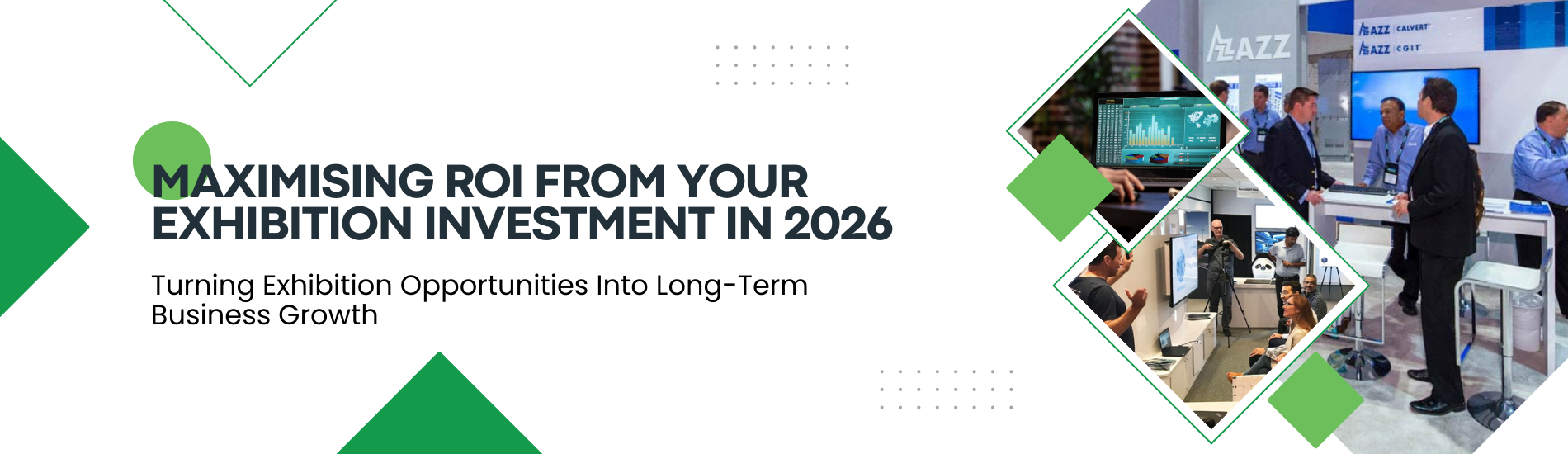
Maximising ROI From Your Exhibition Investment in 2026
Maximising ROI From Your Exhibition Investment in 2026
Turning Exhibition Opportunities Into Long-Term Business Growth
Most companies can tell you what they spent on their last exhibition. Very few can clearly explain what it returned.
Trade shows bring together thousands of businesses and decision-makers in a short span of time. The Global Association of the Exhibition Industry (UFI) reports that the worldwide exhibition industry hosted around 32,000 exhibitions in 2024, with millions of industry professionals in attendance. What would typically take months of individual meetings can often be achieved within a few days.
However, this access comes at a significant cost. Stand space, logistics, travel, staffing, and marketing materials all require substantial investment.
This raises a critical question for many organisations:
How can exhibition investments generate measurable business value?
In 2026, the most successful exhibitors will not view exhibitions as standalone events. They will see exhibitions as part of a broader marketing approach that starts before the exhibition and continues well after it is over. Understanding this perspective is likely to significantly enhance the overall business benefits of any investment in exhibitions.
Planning for ROI Before the Exhibition Begins
The common misconception about exhibitions is that the actual work starts only when the exhibition opens. However, this is far from the truth, as much of the actual return can be determined even before the exhibition doors are opened.
Preparation has now become an essential factor in determining the actual returns of an exhibition. Research carried out by the Exhibition and Event Association of Australasia (EEAA) indicates that companies that involve their audience before the exhibition attract many more visitors than those that do not.
Exhibitors who are successful tend to use the following pre-exhibition strategies:
- Leveraging LinkedIn, newsletters, and emailers to inform their network about their participation.
- Reaching out to existing clients and prospects to encourage booth visits.
- Scheduling meetings or product demonstrations in advance.
- Showcasing new solutions or upcoming product launches.
This helps them arrive at the exhibition with a plan, rather than just relying on the flow of visitors to their booth.
Focusing on Meaningful Conversations
Several businesses measure the success of an exhibition by the number of visitors who pass by their booth. However, such a measure does not necessarily reflect the potential for doing business.
What matters is the quality of the interactions that are taking place.
Rather than trying to gather as many contacts as possible, successful exhibitors are those who are able to engage in meaningful interactions that reflect potential. This is because such a measure helps the company understand the visitors who are likely to become clients.
Exhibition teams that are successful at generating more ROI are those that:
- Identify decision-makers or influencers.
- Pose questions that help them understand real business needs.
- Showcase the potential of their products to satisfy those needs.
- Record information gathered from the interactions.
Using Technology to Capture and Organise Leads
Digital lead capture tools are becoming a key aspect of trade show marketing strategies.
According to 68% of event professionals, utilising technology to enhance visitors' experiences at events is a trend that will remain essential.
Digital lead capture tools enable exhibitors to:
- Collect visitor information immediately using QR codes or badge scanning.
- Make notes regarding visitor interests or project requirements.
- Organise leads according to priority or industry type.
- Automatically input information into a CRM system.
By organising this information during the event, a company can ensure that every interaction is contributing to a cohesive post-event strategy.
Measuring Success Beyond the Event
Another reason why exhibitions are often considered to provide low returns is that companies only tend to look at them during the event.
However, it is believed that the actual benefit of attending trade shows is often made apparent weeks or months after attending.
Rather than looking at visitor numbers, it is now more common to look at exhibitions and evaluate them using more general metrics.
This can include:
- Qualified leads identified
- Meetings scheduled
- New sales opportunities created
- Strategic partnerships developed
According to research carried out by Freeman’s Trade Show Trends Report, exhibitions are essential in developing long-lasting professional associations. The report indicates that 51% of attendees are encouraged to revisit an event in the future if they have positive experiences in networking. Apart from that, 63% of attendees believe that subject matter experts significantly contribute to positive experiences in networking.
This again stresses the importance of looking at exhibitions based on long-term opportunities rather than immediate outcomes.
The Value of Timely Follow-Ups
Those visitors who express interest during the exhibition are usually exploring a number of potential suppliers or solutions. Companies that respond quickly are significantly more likely to stay in their minds throughout this process.
Some of the most effective ways to follow up include:
- Sending personalized emails that reference the initial conversation
- Providing documentation, information, or case studies
- Arranging in-depth product demonstrations or consultations
- Using social media networking tools such as LinkedIn
Quick responses are key to appearing professional and to capitalising on the momentum generated during the exhibition.
Treating Exhibitions as Part of a Larger Strategy
The most important change in exhibition marketing is the recognition of the fact that trade shows must not be held in isolation.
Many organisations today are recognising the value of including trade shows within their marketing and sales strategies. This helps companies to build better relationships with their clients, understand their competitors, launch new innovations, and explore new markets. This can, therefore, be beneficial for them beyond the exhibition itself.
Final Thoughts
Exhibitions are still important in creating business relationships and exploring business opportunities. However, it is important to note that attending an exhibition alone is not enough to ensure results.
Maximising ROI is a process that requires a lot of planning before, during, and after an exhibition.
The most successful exhibitors in 2026 will not just show up, but show up with intent. Because in the end, it is not the number of conversations that matters, but what those conversations lead to.
Latest Blogs


© Copyright by FOUNTAINHEAD INTERNATIONAL B.V. || Designed and maintained by S2code